
With millions of apps competing for attention across major app stores, building a strong product is only one part of the growth equation. Users need to discover the app, understand its value and have enough confidence to install it. For app marketers, this makes visibility and conversion within the app store increasingly important.
This is where App Store Optimization (ASO) comes in. App Store Optimization is the process of improving an app’s visibility and conversion within app stores to increase relevant organic installs.
In this guide, let’s explore what app store optimization is, how it works, the factors that influence performance, how marketers can build an effective ASO marketing strategy and more.
What Is App Store Optimization?
App Store Optimization is the practice of improving an app’s presence within an app store so that it can be discovered by relevant users and convert that visibility into installs.
While it shares similarities with search engine optimization, ASO operates within the specific search and discovery environments of app stores. At its core, ASO has two connected objectives.
- Discoverability: Helping the right users find an app when they search for relevant terms, categories or solutions.
- Conversion: Convincing those users that the app is worth installing once they reach its product page.
These two objectives are closely connected. An app can rank well for an important keyword and still generate limited growth if its product page does not communicate its value effectively.
Similarly, a highly persuasive product page has limited value if potential users cannot find it in the first place. ASO, therefore, brings together several elements, including keyword research, app titles, subtitles, descriptions, screenshots, ratings, reviews and more.
However, here’s one thing brands and marketers need to know: ASO is not a one-time exercise. Search behavior changes, competitors update their listings, new features are introduced and user expectations evolve. Hence, ASO is something that requires continuous research, testing, and optimization.
How Does App Store Optimization Work?
App stores use algorithms to determine which apps appear in search results and how they are presented to users. These systems assess different signals to determine an app’s relevance and how effectively its listing meets user expectations.
ASO works by aligning an app’s store presence with these signals while also improving the experience for users who discover it. When users search for an app, the store evaluates the relevance of available listings and determines which results to surface. Once users reach a listing, their response to the page can influence how effectively that visibility translates into installs.
The exact signals and their relative importance vary between Google Play Store and Apple’s App Store. This is why ASO requires a platform-specific approach rather than applying the same optimisation method across both stores.

Why Is App Store Optimization Important?
ASO matters because app discovery has become increasingly competitive. Even a strong app can struggle to acquire users if it does not appear for relevant searches or fails to communicate its value once users reach the product page.
Improves App Discoverability
The first requirement for organic growth is being found.
Users search app stores with specific needs, problems and interests. An app that understands these search behaviors can optimize its metadata around relevant terms and improve its chances of appearing for those searches.
The objective is not simply to rank for as many keywords as possible. Relevance matters. Appearing for a search that has little connection to the app may create visibility without meaningful acquisition.
Increases Organic Installs
Improved visibility can create more opportunities for organic downloads by helping relevant users discover the app through search. Basically, when an app consistently appears for searches that align with user needs, it can result in a steady flow of relevant installs and support more sustainable app growth.
Moreover, ASO helps you acquire high-intent installs. Because when someone is actively searching for a budgeting app, language learning tool or food delivery service, they have already expressed a need.
Marketers can optimize their app around relevant searches to connect the product with users whose intent is more closely aligned with its value proposition.
Can Reduce Dependence on Paid Acquisition
ASO can strengthen an app’s overall acquisition mix by creating a stronger source of organic discovery. At the same time, an optimized store listing can improve the experience for users who arrive through paid campaigns, helping more of that traffic translate into installs.
What Are the Key Factors of App Store Optimization?
A strong ASO strategy brings together multiple optimisation areas, each influencing a different stage of the app discovery journey. From helping users find the app to building enough relevance and confidence to drive installs, these factors work together to shape how an app performs in the store.
Keyword Research and Optimization
Keyword research is one of the foundations of ASO because it reveals how potential users search for apps, products and solutions. The process should start with the app itself: What problem does it solve? What features does it offer? Which categories does it compete in? Understanding these fundamentals helps identify the search terms most closely aligned with the app’s value proposition.
Competitor research can then uncover additional opportunities by showing which terms competing apps target, where gaps exist in their positioning and how users describe similar products in reviews. Effective keyword research should consider:
- Search intent
- Search volume
- Relevance
- Competition
- Keyword placement
The objective is not to maximize the number of keywords used, but to identify the terms that offer the strongest combination of relevance, user intent and search opportunity. Since search behavior and metadata requirements differ between Google Play and Apple’s App Store, keyword strategies should be tailored to each platform rather than applied uniformly.
App Name, Title and Subtitle
The app name and supporting metadata are among the first elements users encounter.
They should communicate what the app does clearly while incorporating relevant terminology where appropriate. The challenge is balancing search relevance with readability and brand recognition.
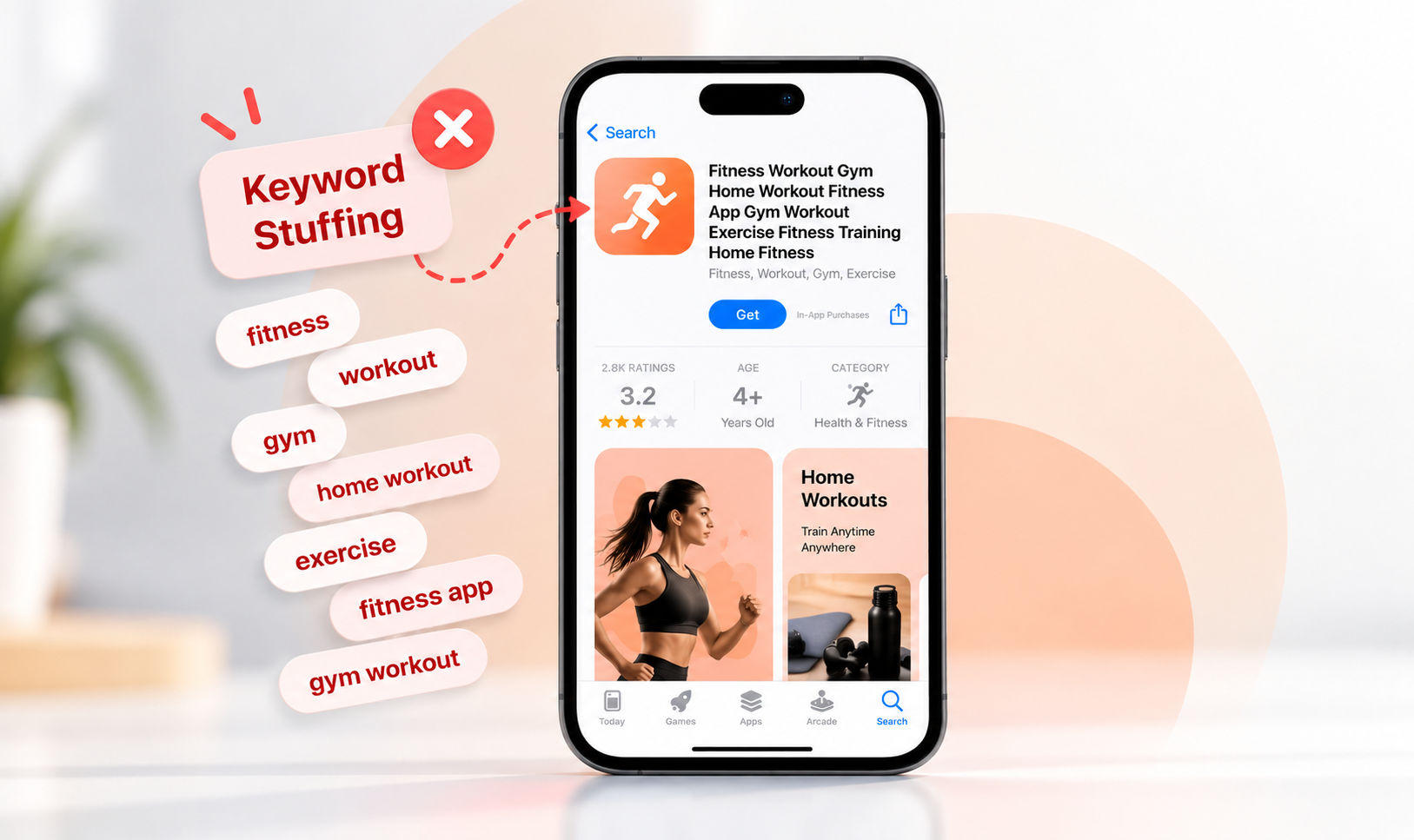
An app title should not become a collection of keywords. Users need to understand the product quickly, and excessive keyword usage can make the listing feel unnatural.
Marketers should keep three principles in mind when writing the app name, title and subtitle:
- Keep it short: Use concise, clear language that communicates the app’s purpose quickly.
- Balance the brand and keywords: Lead with the brand name and, where the brand is still building recognition, incorporate the closest relevant keyword to clarify what the app offers.
- Avoid unnecessary terms: Keep jargon, pricing references and promotional words such as “free” out of the app name, title and subtitle.
App Description and Metadata
Descriptions provide an opportunity to explain the product in greater detail and reinforce its relevance.
The approach differs between Apple’s App Store and Google Play. The two platforms have different metadata structures and indexing approaches, so marketers should not simply copy the same optimization strategy across both.
The description should communicate the product’s value rather than becoming a list of search terms. Keep the following principles in mind:
| Do | Avoid |
|---|---|
| Explain the product clearly | Repetitive keyword usage |
| Integrate relevant terminology naturally | Unclear product claims |
| Focus on user benefits | Writing exclusively for algorithms |
| Make the most important information easy to understand | Treating the same metadata strategy as universal across platforms |
App Icon, Screenshots and Preview Videos
Once users reach an app listing, visual assets become critical to conversion. They should answer one simple question: Why should I install this app?
Rather than simply displaying interface elements, marketers must communicate the product experience, important features and practical benefits.
The strongest visual assets tend to make the value proposition understandable without requiring users to read every line of the description. Marketers should focus on:
- Leading with the primary benefit
- Creating a logical flow across screenshots
- Establishing clear visual priorities
- Showing meaningful functionality through preview videos
- Ensuring the creative matches the user's search expectations
Ratings and Reviews
Ratings and reviews influence how users perceive an app before installation. A strong rating can provide an immediate trust signal, while detailed positive reviews can reinforce the product’s value.
As a practical benchmark, maintaining a rating of 4.0 or above can help establish credibility, while ratings closer to 4.5 or higher can provide a stronger trust signal. Negative reviews, meanwhile, can expose friction points that marketers and product teams need to understand.
Hence, it is imperative to treat reviews as a strategic business tool rather than merely a reputation management exercise. They can provide:
- Social proof that builds trust and credibility
- User feedback that reveals customer sentiment and expectations
- Product insights that inform improvements and innovation
- Conversion signals that influence purchase decisions
- Opportunities to identify recurring problems and address underlying customer pain points
Localization for Different Markets
Localization is more than translating an app listing into another language. A robust ASO strategy should adapt to the regional and language differences that shape how users search for, evaluate and respond to an app.
Search behavior, terminology, cultural references, user expectations and competitive environments can vary significantly between markets. For example, the language users use to search for a financial product may differ across markets, even when the underlying product remains the same.
A strong ASO strategy therefore treats each market as a distinct search and conversion environment rather than applying the same listing everywhere. This means it can adapt keywords, app copy, screenshots, visual messaging, and product positioning from region to region.
Common ASO Mistakes to Avoid
Even well-planned ASO strategies can underperform when optimization becomes too narrow.
1. Keyword Stuffing
Adding keywords repeatedly does not automatically improve relevance. Search terms should be incorporated naturally and in a way that remains useful to users.
2. Optimizing Only for Rankings
A high ranking is an important part of ASO marketing, but it is not the final objective. If visibility does not translate into product page engagement and installs, the strategy needs to look beyond rankings. An app can generate significant impressions and still underperform if the product page fails to communicate its value.
3. Making Decisions From Insufficient Data
Not every change produces an immediate or statistically meaningful result. Testing needs enough data to support a reliable conclusion, particularly when evaluating changes to keywords, metadata or creative assets. Give each test sufficient time and traffic before assessing its impact. This makes it easier to distinguish genuine improvements from temporary changes and build future optimization decisions on reliable evidence.
4. Treating ASO as a One-Time Project
Search behavior, competition and app experiences change continuously. A listing that performs well today may require optimization as the market evolves.
How Long Does It Take to See Results From ASO?
There is no universal timeline for ASO results. The impact of an optimization can vary based on the competitiveness of the category, the popularity of the app, the volume of search activity, the scale of existing traffic and the nature of the change being tested.
Some changes may produce observable shifts relatively quickly, while others require more time and data before a reliable conclusion can be reached.
Conclusion
App Store Optimization is often reduced to keywords, rankings and app descriptions. In reality, it is a broader growth discipline that connects discoverability with conversion.
The strongest ASO strategies understand what users are searching for, create relevant store experiences, communicate product value clearly and continuously learn from performance data. Keywords help users find an app, metadata helps establish relevance, visual assets help communicate value, ratings and reviews build trust, and testing helps determine what works.
The goal of ASO is not simply to rank higher. It helps ensure that when a user searches for a solution your brand provides, your app is discovered, understood and ultimately chosen.
Frequently Asked Questions
1. Is App Store Optimization important?
Yes, App Store Optimization is important because it helps apps become more discoverable, attract relevant users and improve conversion within app stores. A well-optimized listing can increase organic installs, strengthen user confidence and reduce reliance on paid acquisition. For app marketers, ASO also provides a structured way to improve app store performance over time.
2. How do you do App Store Optimization?
App Store Optimization involves researching relevant keywords, optimising the app name, subtitle and description, improving visual assets, encouraging positive ratings and reviews, and localising the listing for different markets. Marketers should also test listing elements, monitor performance metrics and continuously refine their approach based on changes in user behavior and search performance.
3. How is ASO different from SEO?
ASO and SEO both focus on improving discoverability through search, but they operate across different environments. SEO helps websites rank on search engines such as Google, while ASO focuses on app visibility within app stores.